


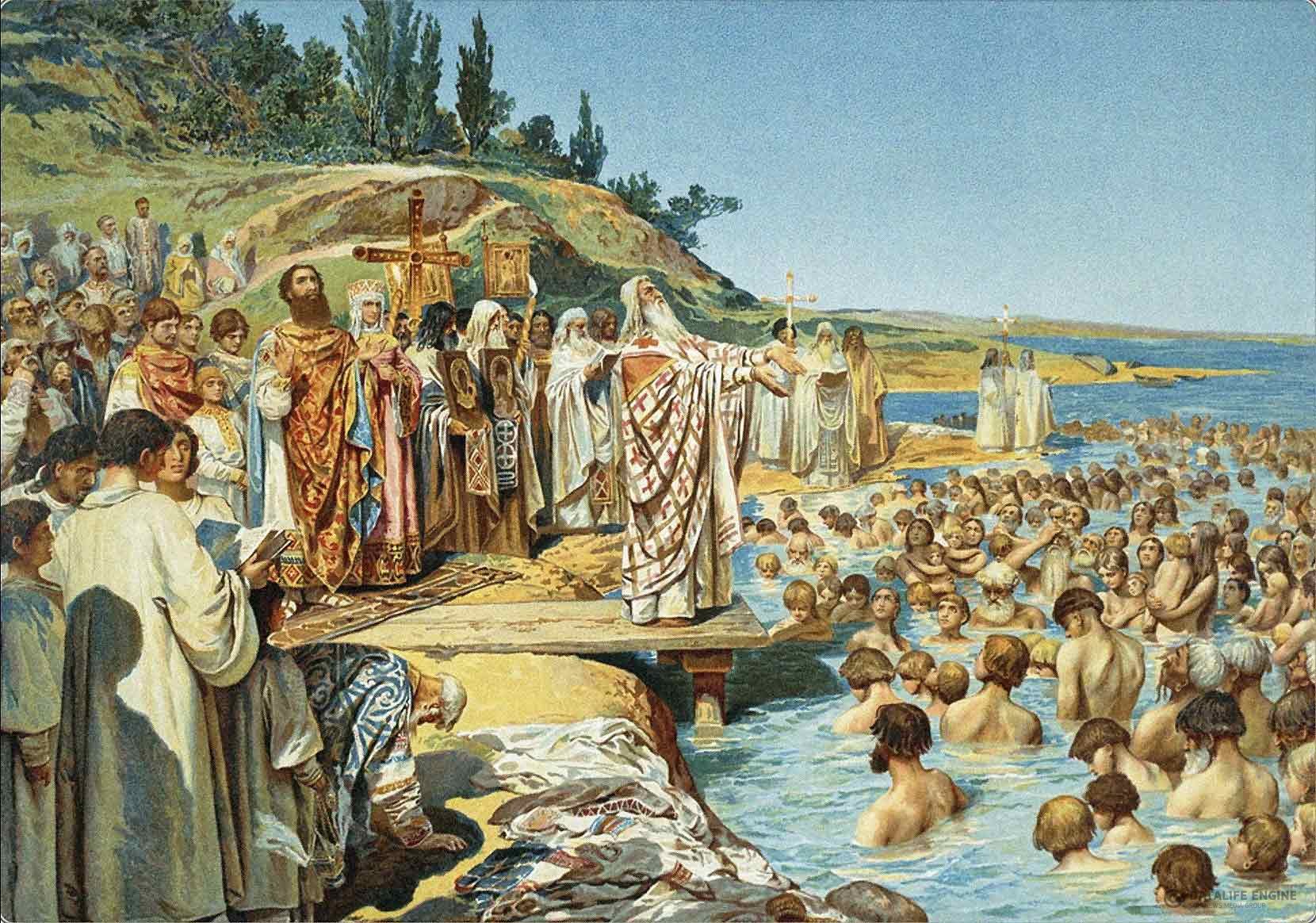
 Every year in the height of summer, we look back in ourminds to an event that became a defining turning point in the history of theEastern Slavs. The Christianization of Rus' took place in 988 by the will ofthe Grand Prince of Kyiv, Vladimir Svyatoslavich. This date is recorded inhistory books, and the holiday itself is celebrated annually on July 28th. TheDay of the Baptism of Rus' marks the moment when fragmented lands found aunified spiritual and political backbone—the birth of a new statehood thatdetermined the cultural vector of a vast region for centuries to come.
Prior to adopting Christianity, the Slavic tribes wereby no means living in a cultural vacuum. It was a distinctive world boastingdeveloped crafts, rich folklore, a strong communal way of life, and a profound,poetic perception of nature. The Slavs knew how to wage war, trade, and forgeenduring alliances. However, by the late 10th century, the Old East Slavicstate faced a severe internal challenge. The vast territory stretching from theBaltic to the Black Sea remained a patchwork quilt. Each tribe—be it thePolyane, Drevlyane, or the Ilmen Slavs—had its own ancestral idols andprovincial interests. As the young power grew rapidly and asserted itself onthe international stage, old pagan cults could no longer serve as a reliablepillar for supreme authority or bind the people into a single whole.
Recognizing this, Prince Vladimir Svyatoslavich resolvedupon a radical reform. Chronicle lore tells of the "test of faiths,"during which the prince sought the most durable spiritual foundation for hisstate. Byzantine Orthodoxy attracted Rus' not only through the beauty of itsliturgy but also by the very concept of a strong, centralized state power wherethe ruler's authority was sanctified by divine law. An alliance with thepowerful and enlightened Byzantine Empire opened up fundamentally new geopoliticalhorizons for Rus'.
The fateful choice was made in 988. Having receivedbaptism in Chersonesus in Crimea, Prince Vladimir returned to Kyiv, and thewaters of the Dnieper became the baptismal font that united the capital'sinhabitants. Step by step, city by city, the new faith wove a Christian threadthrough Novgorod, Rostov, Murom, and other lands, transforming tribal alliancesinto a single monolithic people with a shared identity.
Along with the new state religion, Rus' inherited acolossal stratum of Byzantine culture. The adoption of Christianity brought theSlavic script, created by the enlighteners Cyril and Methodius, giving apowerful impetus to the development of schools, bookcraft, and chroniclewriting. Instead of the traditional wooden architecture, monumental stoneconstruction emerged in Rus'—majestic cathedrals rose across the land, becomingsymbols of the new power’s might and grandeur. Harsh tribal laws were replacedby different values: the concepts of personal responsibility, mercy, and publiccharity.
This process of state and spiritual building in Rus' wasclosely intertwined with the fate of the entire Slavic world, which underwentsimilar transformations in the 9th and 10th centuries. The adoption ofChristianity in different regions shaped the future cultural map of Europe.While the West Slavs—Poles and Czechs—received baptism from Rome, aligningthemselves with the Latin tradition, the South and East Slavs chose theByzantine vector. Christian Bulgaria, which had been baptized slightly earlier,became a vital cultural donor for Rus', passing on the first Slavic books.Serbia shared this path as well.
Although the historical paths of the Slavic peopleseventually diverged, it was the Kyiv font that became the common cradle fromwhich the Russian, Belarusian, and Ukrainian nations emerged. Today, the Day ofthe Christianization of Rus' reminds us of how shared spiritual roots, theacquisition of literacy, and the statesmanship of our ancestors helped forge agreat civilization capable of weathering any historical storm.